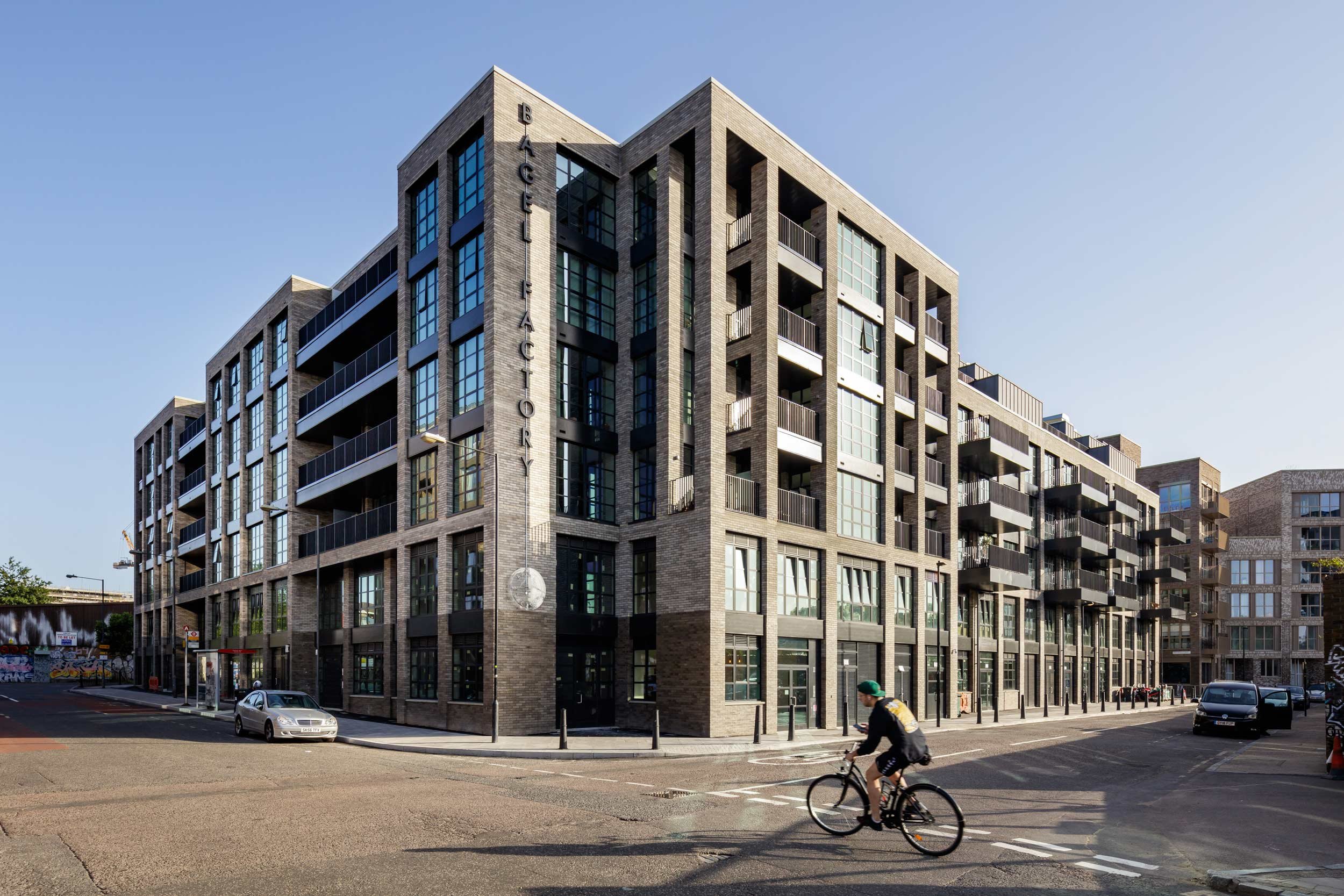
Bagel Factory
Reinventing Hackney Wick’s industrial heritage with vibrant spaces for living and creativity.
The Bagel Factory development in Hackney Wick is a vibrant mixed-use project completed in 2019. Spanning approximately 70,000 square feet, it includes 181 residential units alongside commercial spaces that support the area's dynamic community and creative industries. The development reflects the industrial heritage of Hackney Wick with a modern twist, blending innovative architectural design with functionality to cater to urban living demands.
| Location | Hackney Wick, London, E9 |
| Architect | HWO Architects |
| Client | Aitch Group |
| Sector | Residential Developments |
| Photography | Fotohaus |
| Location | Hackney Wick, London, E9 |
| Architect | HWO Architects |
| Client | Aitch Group |
| Sector | Residential Developments |
| Photography | Fotohaus |
Reinventing Hackney Wick’s industrial heritage with vibrant spaces for living and creativity.
The Bagel Factory development in Hackney Wick is a vibrant mixed-use project completed in 2019. Spanning approximately 70,000 square feet, it includes 181 residential units alongside commercial spaces that support the area's dynamic community and creative industries. The development reflects the industrial heritage of Hackney Wick with a modern twist, blending innovative architectural design with functionality to cater to urban living demands.


The project posed several structural and construction challenges due to its urban location, mixed-use design, industrial contamination issues, local flood zone requirements and sustainability goals. Located in a dense area with limited site access, managing logistics and minimising disruption to the community were also key considerations.
The project posed several structural and construction challenges due to its urban location, mixed-use design, industrial contamination issues, local flood zone requirements and sustainability goals. Located in a dense area with limited site access, managing logistics and minimising disruption to the community were also key considerations.


The building’s structural design features a reinforced concrete frame supported on a piled raft slab to limit excavation. Flat slabs with blade columns provide flexibility, while a transfer structure at the first floor accommodates open-plan commercial spaces below and residential units above. This efficient design balances functionality, load management, and integration with the site’s urban context.
The building’s structural design features a reinforced concrete frame supported on a piled raft slab to limit excavation. Flat slabs with blade columns provide flexibility, while a transfer structure at the first floor accommodates open-plan commercial spaces below and residential units above. This efficient design balances functionality, load management, and integration with the site’s urban context.


Sustainability was prioritised through the use of environmentally friendly materials and methods. Overcoming these challenges involved close collaboration between the design team, contractors, and stakeholders, delivering a development that aligns with the area’s character and community needs.
Sustainability was prioritised through the use of environmentally friendly materials and methods. Overcoming these challenges involved close collaboration between the design team, contractors, and stakeholders, delivering a development that aligns with the area’s character and community needs.

Awards & Nominations
2019
Planning Awards – Excellence in Placemaking at High Densities
Winner
Related Projects
-

Empress Works
Residential Developments
-

Weston Street
Residential Developments
-

WME & Canal Place
Residential Developments